
By now, monsoon should have reached the central India, including parts of Madhya Pradesh, Rajasthan, eastern Uttar Pradesh and Gujarat, but it is yet to reach Maharashtra.

The delay in the current year's monsoon rains has heightened uncertainty over India's economic growth and pushed up the risks of a drought, according to a leading independent forecaster.\n\n\n\n

Sri Lanka meteorological department predicts better weather in coming days

Till June 30, the southwest monsoon was 33 per cent lower than normal, which is among the worst in the last five years, with 28 of the 36 meteorological divisions recording deficient rain.

Monsoon is likely to be 96 per cent of the long period average

Intermittent, widespread rains lashed Chennai and other regions of Tamil Nadu on Tuesday and the India meteorological department said the low pressure area over the Bay of Bengal has turned into a well-marked low pressure area and it is likely to become a depression.

"The season averaged maximum temperatures in Himachal Pradesh, West Rajasthan, Konkan, Goa, Coastal Karnataka, Kerala and Arunachal Pradesh are likely to be higher than normal by 0.5-1.0 degree Celsius," the Met department has said in its forecast.

The country's unemployment rate in July fell to 6.80 per cent, the lowest level in the last six months, amid rising agriculture activities during monsoon, according to Centre for Monitoring Indian Economy (CMIE) data. The unemployment rate dropped to 6.80 per cent in July from 7.80 per cent in June, the CMIE data said. Rural unemployment declined 6.14 per cent to 272.1 million last month from 265.2 million or 8.03 per cent in June, it said.

Meteorologists earlier said Cyclone 'Biparjoy' had been impacting the intensity of the monsoon and that its onset over Kerala would be 'mild'.

A third of FMCG sales and half of motorcycle sales come from the hinterlands

As the growth figures relate to pre-Covid lockdown period it does not reflect the real picture of distress which unfolded from April onwards in the sector, when acute supply disruption led to sharp drop in prices of many commodities largely perishables impacting farmers.
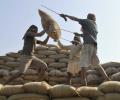
For many farmers, though, a bumper harvest isn't good news, as they have been forced to sell their produce, particularly pulses, dirt cheap.

July and August are expected to receive 107 per cent and 104 per cent of rainfall

Officials said good rain in August - though it might not improve acreages much for most crops except urad, moong, and paddy - would help in improving yields in the crops already planted.

The El Nino impact on the Indian monsoon typically manifests by way of extended break in rainfall.

With rainfall and monsoons becoming highly unpredictable partly due to climate change and partly due to usual changes in weather patterns, it is such innovations by IMD which will help in planning better, reports Sanjeeb Mukherjee.

Next week could see some respite from the heat.

Till July 26, kharif crops have been sown in around 68.87 million hectares, which is 6.43 per cent lower than the area covered during the same period last year.

The Reserve Bank of India (RBI) has identified "climate shocks" as a risk to food inflation rates and overall price rise while stating that the outlook for the country's economic growth remains bright. In its Annual Report for 2023-24, released on Thursday, the central bank said easing supply-chain pressures, broad-based softening in core inflation, and early indications of an above-normal southwest monsoon meant well for the inflation outlook in 2024-25. "The increasing incidence of climate shocks, however, imparts considerable uncertainty to the food inflation and overall inflation outlook," said the RBI while noting headline inflation moderated by 1.3 percentage points on an annual average basis to 5.4 per cent in 2023-24.

In another forecast for August, IMD Director General Mrutunjay Mohapatra said monsoon is also likely to be normal in the month.

Brihanmumbai Municipal Corporation commissioner and administrator Iqbal Singh Chahal also appealed to citizens to save water and use it judiciously.

El Nino is expected to occur in August-September, but it is unlikely to have any major impact on the monsoon, and the weatherman expects a positive Indian Ocean Dipole, which has a strong influence on rainfall in the country.

Prime Minister Modi last week called for optimal grain storage, fire audits and mock drills in hospitals as preparations for the harsh summer forecast by the meteorological department.

The Centre will review the situation on a fortnightly basis.

Close to half the country is experiencing deficient rains and the shortage for the figure has gone up to 16 per cent.

The minimum temperature in Delhi was recorded at 28.6 degrees Celsius, according to the India Meteorological Department (IMD).

After a steady surge, prices of pulses, except those of urad and masoor to some extent, are showing signs of stabilising amid a revival of monsoon rains over major growing areas of Maharashtra and Karnataka, and on expectations of a rise in imports. Chana prices, which too had moved up in recent months, have dropped by almost 3 per cent since the end of August due to increased liquidation of government stocks, official data shows. Monsoon rains seem to have benefitted the standing soybean crop as well.

As rains continue to lash across Kerala days ahead of the expected onset of Southwest monsoon, the India Meteorological Department (IMD) on Sunday issued a red alert in five districts of the state for Sunday and Monday indicating extremely heavy rainfall.

After the west coast, another cyclone is likely to hit the east coast by May 26-27, the India meteorological department said on Wednesday.
The sluggish southwest monsoon, which yielded one of the driest Junes in a century this year, appears disappointing this month as well.

Rain for the central and northwestern parts a concern.

From the Sensex pack, Power Grid, Infosys, Asian Paints, Mahindra & Mahindra, HCL Technologies, IndusInd Bank, Tech Mahindra, Bajaj Finance, Wipro, Tata Consultancy Services, HDFC Bank and Titan were the major gainers. Tata Steel and Bharti Airtel were the laggards.

For the second successive year, Monsoon is likely to be below normal with parts of north-west and central India to be the most affected.

Tomato prices have been on the boil for more than a month. Data from major cities show that the spike has been between 125 and 150 per cent at the wholesale level. Soaring vegetable prices, including tomatoes, pushed the retail inflation rate to a nine-month high of 5.49 per cent in September, according to government data. Though reports say prices are expected to come down in the next few weeks after supplies improve from Madhya Pradesh and Himachal Pradesh, how long will the respite last is anybody's guess.

As the southwest monsoon continues to narrow its overall deficit, the India Meteorological Department (IMD) on Wednesday exuded confidence that the dreaded El Nino weather pattern was unlikely to affect monsoon rains this year.

The IMD came out with a dismaying prediction.

Good monsoon is likely to create more jobs in the agriculture sector, which in turn could save the exchequer around Rs 10,000 crore
The rains in August have also led to speculation that if the trend continues, rains in September, the terminal month of the four-month monsoon season, could be better, thus aiding production of paddy and other kharif crops.

The markets had touched their highest levels in a month.

Rainfall in August is predicted to be below normal (less than 94 per cent of LPA), but the situation is expected to improve comparatively in September, the IMD said.
